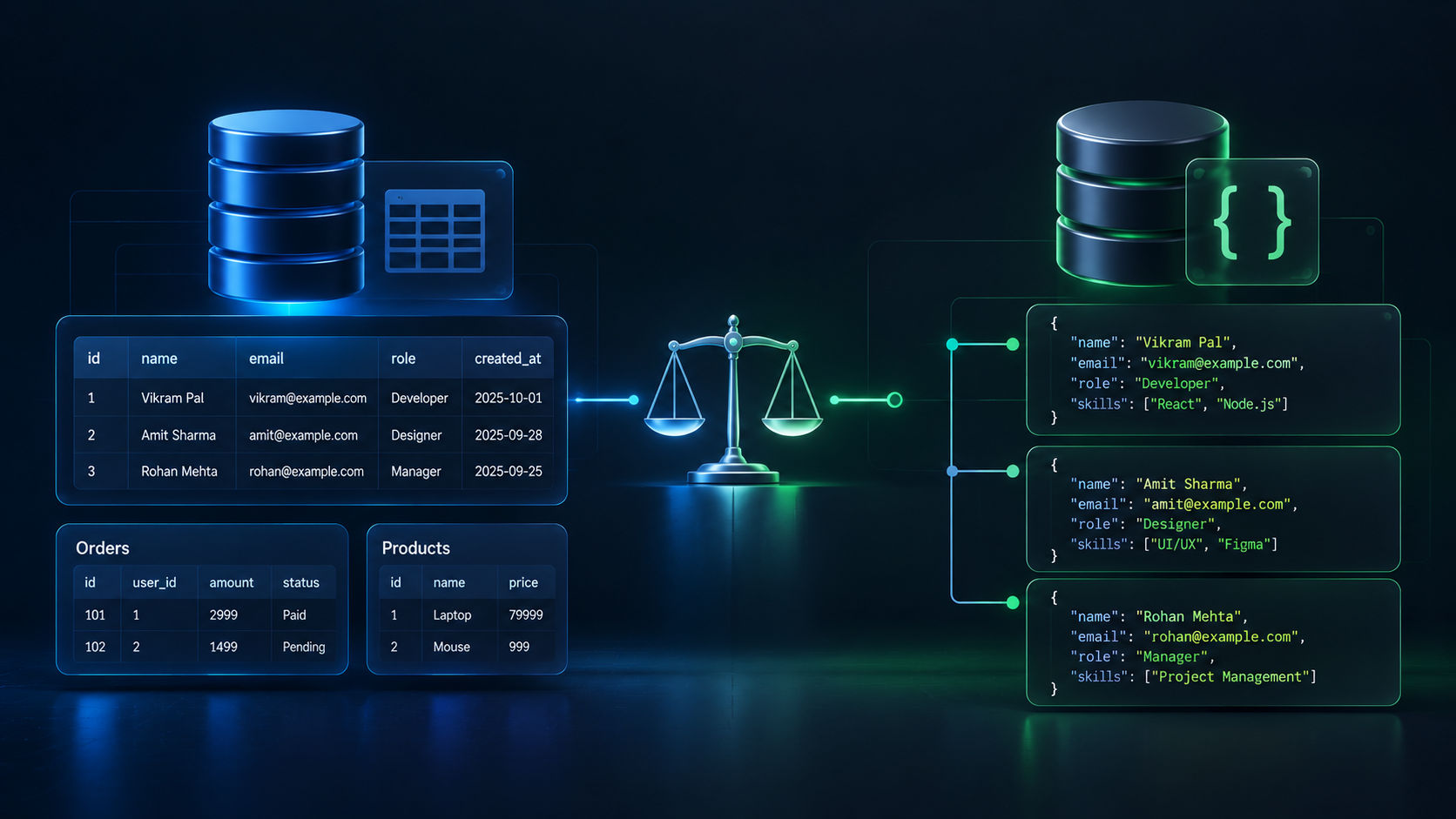
1. The Core Dilemma: What Powers Your Web Application?
Every web application needs a reliable way to store, organize, and retrieve data. Early in a project, developers and business owners face an important decision: which database should they use?
That choice can affect how easily an application handles new features, manages relationships between records, and grows as more people use it. A database that suits the project today should also support its likely needs as the product develops.
Two common options are relational databases, which use SQL and include PostgreSQL and MySQL, and document databases such as MongoDB, which belongs to the NoSQL family. Both are used in production, but they solve problems in different ways. This guide looks at how they work, where each one fits, and what to consider before making a decision.
2. Understanding the Basics: SQL vs. NoSQL
What Is an SQL Database?
Relational databases organize information into tables made up of rows and columns. Tables can be connected through relationships, often using primary keys and foreign keys. SQL (Structured Query Language) is used to create, read, update, and manage this data.
This structure is useful when information has clear relationships or when an application needs reliable transactions across multiple records. If you are new to SQL, the W3Schools SQL tutorial is a useful place to explore basic syntax, tables, and joins.
- Popular examples: PostgreSQL, MySQL, SQLite, and MariaDB.
- Storage model: Structured tables with defined columns and data types.
- Key strength: Support for ACID transactions, which help maintain data consistency and reliability when operations succeed or fail.
What Is MongoDB?
MongoDB is a NoSQL database that stores information as documents rather than rows in traditional tables. These documents use a JSON-like structure and are stored internally in BSON, a binary representation of JSON.
A document can contain fields and nested data, and documents in the same collection do not all need to follow an identical structure. This flexibility can be helpful when an application works with varied or evolving data. You can explore its basic concepts in the W3Schools MongoDB tutorial:
- Storage model: Collections of flexible, JSON-like BSON documents.
- Key strengths: Adaptable data models, a developer-friendly document structure, and support for horizontal scaling through sharding.
3. Direct Comparison: Key Architectural Differences
| Feature | SQL Databases (e.g., PostgreSQL, MySQL) | MongoDB (NoSQL) |
|---|---|---|
| Data format | Tables, rows, and columns | JSON-like documents stored as BSON |
| Schema structure | Usually defined through tables and column types; changes may require migrations | Flexible document structure; validation rules can still be applied |
| Relationships | Native joins and foreign-key relationships | References, embedded documents, and $lookup when needed |
| Scaling | Can scale vertically and horizontally, depending on the database and architecture | Supports horizontal scaling through sharding; deployment design still matters |
| Common use cases | Financial systems, ERP platforms, and applications with complex relationships | Content platforms, varied product catalogues, and applications with flexible document data |
4. When Should You Choose SQL?
A relational database is often a strong choice when your application depends on structured information, clear relationships, and transactions that must keep related records consistent.
- Financial and payment workflows: Banking features, subscription billing, and e-commerce payments often involve transactions where accuracy and consistency are essential.
- Complex relationships between records: Applications that connect users, groups, comments, permissions, and other related entities can benefit from relational modelling and SQL joins.
- Structured business information: Employee records, inventory systems, and business registries often have well-defined fields and relationships that fit naturally into relational tables.
5. When Should You Choose MongoDB?
MongoDB can be a good fit when your application handles varied data, benefits from a flexible document structure, or needs to evolve quickly. The best choice still depends on how the data will be queried and updated.
- Fast-moving products and MVPs: When requirements are still changing, a flexible document model can make it easier to adapt data structures as the product develops.
- Content management and product catalogs: Different content types or products may have different attributes. For example, a T-shirt may have size and color fields, while a laptop may need RAM and storage details.
- Activity feeds and event data: MongoDB can support workloads such as activity records, clickstream data, and some IoT use cases, provided the data model, indexes, and cluster are designed for the workload.
- JavaScript and TypeScript applications: MongoDB's document format can work naturally with data used in Node.js and modern JavaScript applications. This can reduce friction when moving JSON-style data between application layers.
6. Production Pitfalls to Avoid
- Pitfall 1: Treating MongoDB like a relational database. MongoDB is often most effective when related data is modelled around the way the application reads and updates it. If your queries repeatedly depend on joining many collections, review whether a relational database would be a better fit. MongoDB also supports $lookup, but frequent joins may indicate that the data model needs another look.
- Pitfall 2: Skipping schema validation. Flexible documents do not mean that every shape of data should be accepted. Use validation at the application or database level. Tools such as Mongoose or Zod can help enforce expected fields and data types, depending on where validation belongs in your stack.
- Pitfall 3: Leaving indexes until performance becomes a problem. Indexes help databases find records without scanning an entire collection or table. Identify common query patterns early and create indexes that support them. Compound indexes can be useful when queries frequently filter or sort by multiple fields, but they should be designed around actual query needs.
7. Conclusion: Making Your Decision
There is no single database that is right for every web application. Start with the shape of your data, the relationships between records, the queries your application needs, and the consistency requirements of important operations.
- If your application relies on structured data, connected records, and multi-step transactions, consider a relational database such as PostgreSQL or MySQL.
- If your data is naturally document-oriented, varies between records, or benefits from a flexible structure, MongoDB may be a suitable option.
Some larger systems use both approaches. For example, a product might store payments and billing records in SQL while using MongoDB for a flexible content catalogue or activity feed. A hybrid setup adds operational complexity, so it should solve a real requirement rather than be adopted by default.
The practical takeaway is simple: choose the database that matches your application's data and workload, not the one that is currently most popular.
8. Need Help Planning Your Web Application?
Choosing a database is one part of designing a dependable web application. The data model, API structure, security, hosting setup, and expected workload all influence how well the system performs as it grows.
At vikrampal.in, I share practical guidance on web development, full-stack architecture, and modern application technologies. If you are planning a website or web application and need help thinking through its technical approach, feel free to get in touch.